

Click Position Report
The Click Position Report measures the relevance of search results for individual keywords on a search client. To view the overall effectiveness of search results on a search client over a specific period, see Average Click Position.
Understanding the Report
The most relevant result for a keyword should appear first. If it does not, use search tuning to improve the results. To determine whether users must scroll to the eighth result or go to the third page to find a document, administrators can use the Click Position Report. The report calculates the mean position (Average Position) and the mode position (Most Clicked Position) of clicked results for each query.
| Search Session 1 | Search Session 2 | Search Session 3 |
| Activity 1: Search "laptop". | Activity 1: Search "laptop." | Activity 1: Search "computer" |
| Activity 2: Click a result on position 6. | Activity 2: Click a result on position 3. | Activity 2: Click a result on position 5. |
| Activity 3: Select a facet. |
Activity 3: Search "computer". |
Activity 3: Search "laptop." |
| Activity 4: Click a result on position 3. | Activity 4: Click a result on position 7. | Activity 4: Click a result on position 3. |
| Activity 5: Clear all facets. |
Activity 5: Select a facet. |
Activity 5: Click a result on position 5. |
| Activity 6: Click a result on position 5. | Activity 6. Select a result on position 5. | SESSION END. |
| SESSION END | SESSION END. |
Based on the data in these three sessions, the click positions for keywords "laptop" and "computer" are:

Most Clicked Position for "laptop" is three because this position occurs the most times in the data.

Most Clicked Position for "computer" is 5 because this position occurs the most times in the data.
Most Clicked Position indicates where users typically find a document in the search results. For example, if the position is 7, you can use search tuning to move the document closer to the top. If the Most Clicked Position is greater than 10, apply search tuning promptly. A position above 10 indicates that the search experience is suffering.
Navigation
-
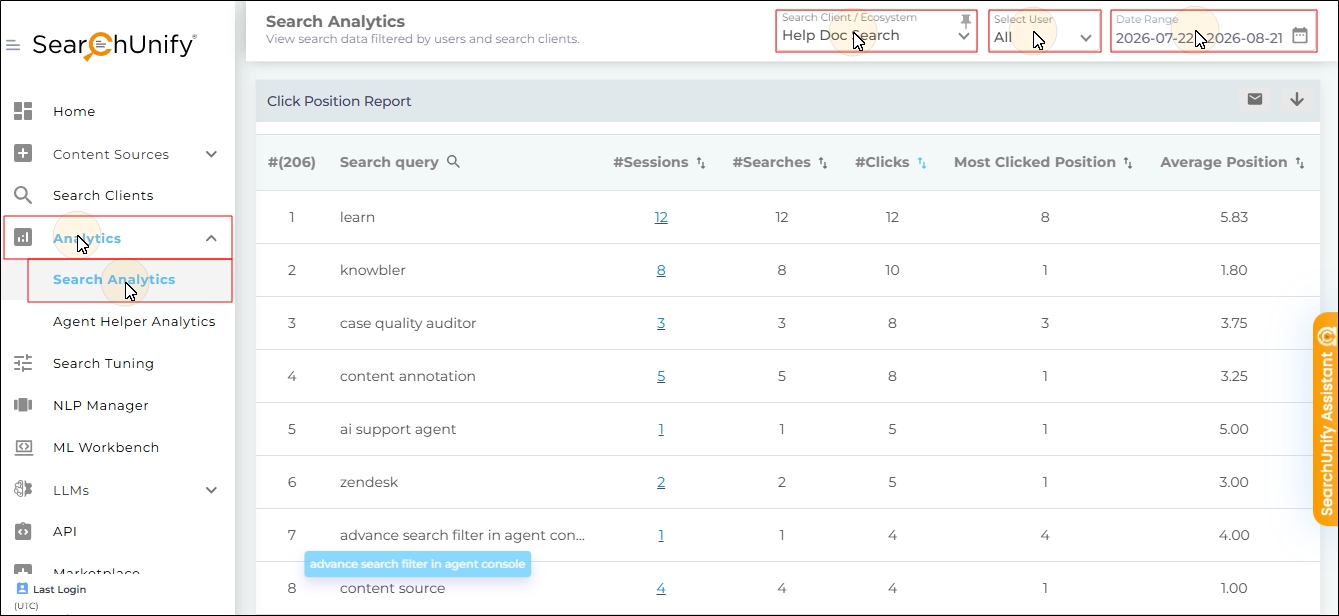
Navigate to Analytics > Search Analytics > Overview.
-
Using the filters Search Client / Ecosystem, Select User, and Date Range, select a search client, user type, and time period.
-
Scroll down to Click Position Report.
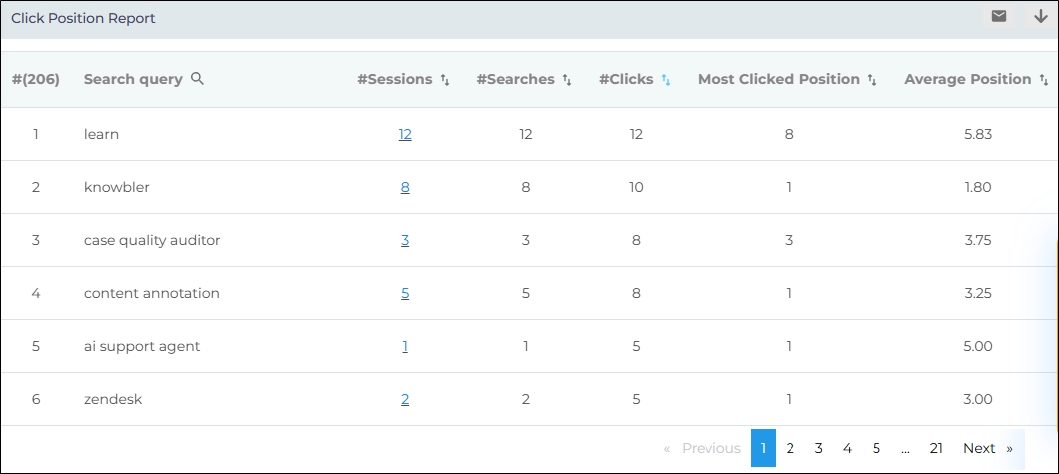
- #(n). The number in parentheses indicates the number of unique search queries
- Search Query.This column lists unique search queries. Regardless of how many times a query is searched, it appears only once in the column.
-
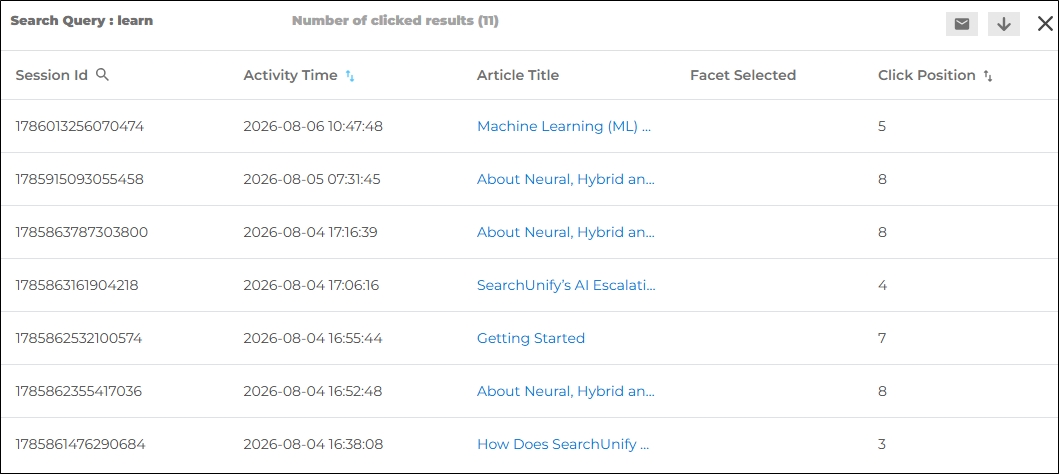
#Sessions. The number of sessions in which a query was searched. Click a session number to view the Session ID, search time (Activity Time), title of the clicked result (Article Title), selected facet (Facet Selected), and Click Position.
The Article Title column contains a link to the clicked article. The Facet Selected column is empty if the user did not apply a facet.
- #Searches. This number of successful searches. Only the searches after which at least one click was made by the user are counted.
- #Clicks.The total number of clicks for a query across all sessions. The report is sorted by the number of clicks, with the most-clicked searches listed first.
- Most Clicked Position: The position at which the specified query receives the most clicks.
-
Average Position: The mean position at which users click results for a query. The formula for mean position is:

Download or Share
Check out Download and Share an Analytics Report
Related
- Back to Overview
- Related article on Average Click Position